Florida General and Limited Partnership Disputes Under Chapter 620
What Does Your Partnership Agreement Say About the Dispute?
The partnership agreement may say who can approve a payment, how the partners divide profits and what happens when a partner wants to leave. If the dispute is over a buyout, look for the clause that sets the price or explains how to calculate it. Read any amendments alongside the original agreement. If the agreement leaves the issue open, check which Chapter 620 rules apply to your type of partnership.
A partnership dispute attorney represents one owner when partners disagree over money, control, information or an exit. Miami partnership dispute attorney Aaron Resnick starts with the partnership or operating agreement, proof of each owner's share and the money that has moved, then chooses negotiation, a buyout, emergency relief or a lawsuit.

Partnership Dispute Attorney in Miami, FL
What Is a Partnership Dispute?
A partnership dispute arises when disagreements occur between business partners regarding the management, direction, or financial interests of the partnership. These disputes can range from minor misunderstandings to major conflicts, and they may involve issues such as:
Breach of contract or fiduciary duty
Disagreements over business decisions or profit sharing
Misappropriation of business assets or funds
Violation of partnership terms or agreements
Disputes related to the valuation or sale of a business
Personal issues or personality clashes between partners
Such disputes can damage not only business relationships but also the overall health of the company. As a result, resolving the conflict quickly and effectively is critical to prevent further harm to the business.
Which Partnership Rules Apply to Your Dispute?
The answer depends on the kind of partnership you have and the decision you dispute. Chapter 620 of the Florida Statutes sets different rules for general and limited partnerships. The partnership agreement can change many of those rules.
If your partner took money from the business, start with the payment in question. Miami business attorney Aaron Resnick reviews the agreement, its amendments and the bank records to see who received the money and who had authority to approve the payment.
Who Gets a Vote in a Florida General Partnership?
Each partner has an equal say in running a Florida general partnership unless the partnership agreement says otherwise. Under the default rules for general partnerships in Chapter 620, a majority of the partners can settle a disagreement about ordinary business. A decision outside the ordinary course of business, or a change to the partnership agreement itself, requires every partner’s consent.
If two partners disagree about an ordinary purchase, the partner who put in more money cannot break the tie on that basis alone. Aaron Resnick checks whether the agreement gives either partner the deciding vote.
What Rights Does a Limited Partner Have in Florida?
General partners usually run a Florida limited partnership. Your role as a limited partner alone gives you no authority to sign for the partnership. You still have a vote on certain decisions. For example, under the default rules in Chapter 620, all partners must approve a change to the partnership agreement.
You can also request financial information. If a payment is in dispute, identify the records you want and explain in writing how they relate to your interest as a limited partner. Aaron Resnick reviews that written request against the partnership agreement before it goes out.
Common Causes of Partnership Disputes
While each partnership dispute is unique, there are several common causes that lead to conflicts between business partners. Understanding these causes can help you address potential issues before they escalate into a larger dispute:
Breach of Fiduciary Duty: Partners in a business owe each other a fiduciary duty, meaning they must act in the best interest of the business and the other partners. If one partner violates this duty by engaging in self dealing, fraud, or other unethical behavior, it can lead to a dispute.
Disagreements Over Profits and Losses: Financial disagreements are among the most common causes of partnership disputes. Conflicts can arise if one partner feels that profits are being unfairly distributed or if there is a disagreement over how losses should be handled.
Management and Control Issues: In many partnerships, conflicts arise due to disagreements over the day to day management and decision making authority. This can be especially problematic if there is no clear agreement on how decisions should be made.
Exit or Dissolution of a Partnership: When a partner wants to leave the business or the partnership is dissolving, disagreements can arise over the distribution of assets, the sale of the business, or the future direction of the company.
Personal Differences: Sometimes, personal differences between business partners can lead to conflict. These issues may include personality clashes, different work ethics, or changes in personal circumstances that impact the business relationship.
How Aaron Resnick Can Help You Resolve Your Partnership Dispute
Miami business attorney Aaron Resnick helps business partners pursue settlement and represents them in court when needed. Our services include:
Legal Consultation: The first meeting reviews your partnership documents and the options for the dispute.
Negotiation and Mediation: In many cases, partnership disputes can be resolved through negotiation or mediation. An arbitrator can hear the dispute and issue a decision outside a court trial.
Litigation Representation: If your dispute cannot be resolved through negotiation, we are prepared to represent you in court.
Partnership Agreement Review and Drafting: A clear agreement can help partners avoid disputes. We can review existing agreements or help you create one that clearly outlines the responsibilities, rights, and expectations of each partner.
Exit Strategy and Dissolution: If you are leaving a partnership or dissolving the business, we handle the buyout or dissolution under Florida law.
Contact The Law Offices of Aaron Resnick
If you are involved in a partnership dispute or are considering suing your business partner, contact The Law Offices of Aaron Resnick for professional legal assistance.
Call 305-672-7495 to schedule a consultation with Miami partnership dispute attorney Aaron Resnick.
When Do You Need a Partnership Dispute Attorney?
You need a partnership dispute attorney when a partner acts without the consent the law or your agreement requires, keeps the books from you, takes partnership money or opportunities, or when someone wants out and the terms are in dispute.
In a Florida general partnership, the partnership agreement governs relations among the partners, and the statute applies where the agreement does not provide otherwise. The agreement may not unreasonably restrict access to books and information or eliminate the duty of loyalty (chapter 620 of the Florida Statutes).
LLC members follow a different statute; see LLC member disputes.
Decisions. By default, each partner has equal rights in management, a majority of the partners may decide a difference over an ordinary course matter, and an act outside the ordinary course, or an amendment to the partnership agreement, needs the consent of all partners.
A new partner needs the consent of all partners, unless the agreement provides otherwise (chapter 620).
Books and information. The partnership must give partners access to its books and records to inspect and copy during ordinary business hours.
Without demand, the partnership and each partner must give a partner any information concerning the partnership's business and affairs that is reasonably required for the proper exercise of the partner's rights and duties. Other information concerning the business and affairs must be given on demand, unless the demand or the information sought is unreasonable or otherwise improper (chapter 620).
Money and opportunities. A partner owes the partnership and the other partners the duties of loyalty and care.
Loyalty includes accounting to the partnership for, and holding as trustee for it, any property, profit or benefit the partner derives from the partnership business or its winding up, or from using partnership property, including a partnership opportunity the partner appropriates (chapter 620). See What Is Breach of Fiduciary Duty?
An exit. A partner is dissociated when the partnership has notice of the partner's express will to withdraw, either immediately or on a later date the partner specifies (chapter 620). The partnership agreement may require that notice to be in writing (chapter 620).
By default, when a partner's departure does not result in dissolution and winding up, the partnership must cause the departing partner's interest to be purchased for a buyout price the statute defines (chapter 620).
A lawsuit. A partner may sue the partnership or another partner, with or without an accounting, to enforce rights under the agreement or the statute (chapter 620).
On a partner's application, a court may order the business wound up on grounds such as another partner's conduct making it not reasonably practicable to carry on the business with that partner (chapter 620).
How Does a Partnership Dispute Case Work in the First 30 Days?
A partnership dispute case starts with the documents, then the preservation of records, then the choice of route: negotiation, a buyout, emergency relief or a lawsuit.
Most of the value in a partnership dispute is created before anything is filed.
The first work is documentary rather than adversarial: locating the operating or partnership agreement and every amendment, establishing who actually holds what percentage and how that was papered, identifying who is authorized to sign and bind the company, and confirming what money has moved and when. In a large share of Florida partnership fights, the agreement already answers the question the owners are arguing about, and nobody has read it closely.
The second work is preservation. Records get deleted, accountants get replaced, and access gets revoked. Getting a preservation demand out early is inexpensive and frequently decides the case later.
Only then does the route question get answered, and the four available routes are laid out on legal options in a Florida partnership dispute.
| Review point | What it answers | What to gather |
|---|---|---|
| Who is involved | Whether the firm can take the case (conflict check) | Legal names of the company, every owner and the other side, including any company the other side controls |
| The agreement | Who decides what, and the exit and buyout terms | The partnership, operating or shareholder agreement with every amendment |
| Ownership | Who holds what share and how it was documented | Ownership records, capital contributions and any change made by handshake |
| Money | What moved, when and to whom | Bank and accounting records, distributions and loans to or from owners |
| Urgency | Whether access is cut, money is moving or a deadline is running | The dates access was cut, money moved and notice was given, and the next deadline |
| Your goal | Whether you want to stay, buy, sell or end the business | One plain sentence describing the outcome you want |
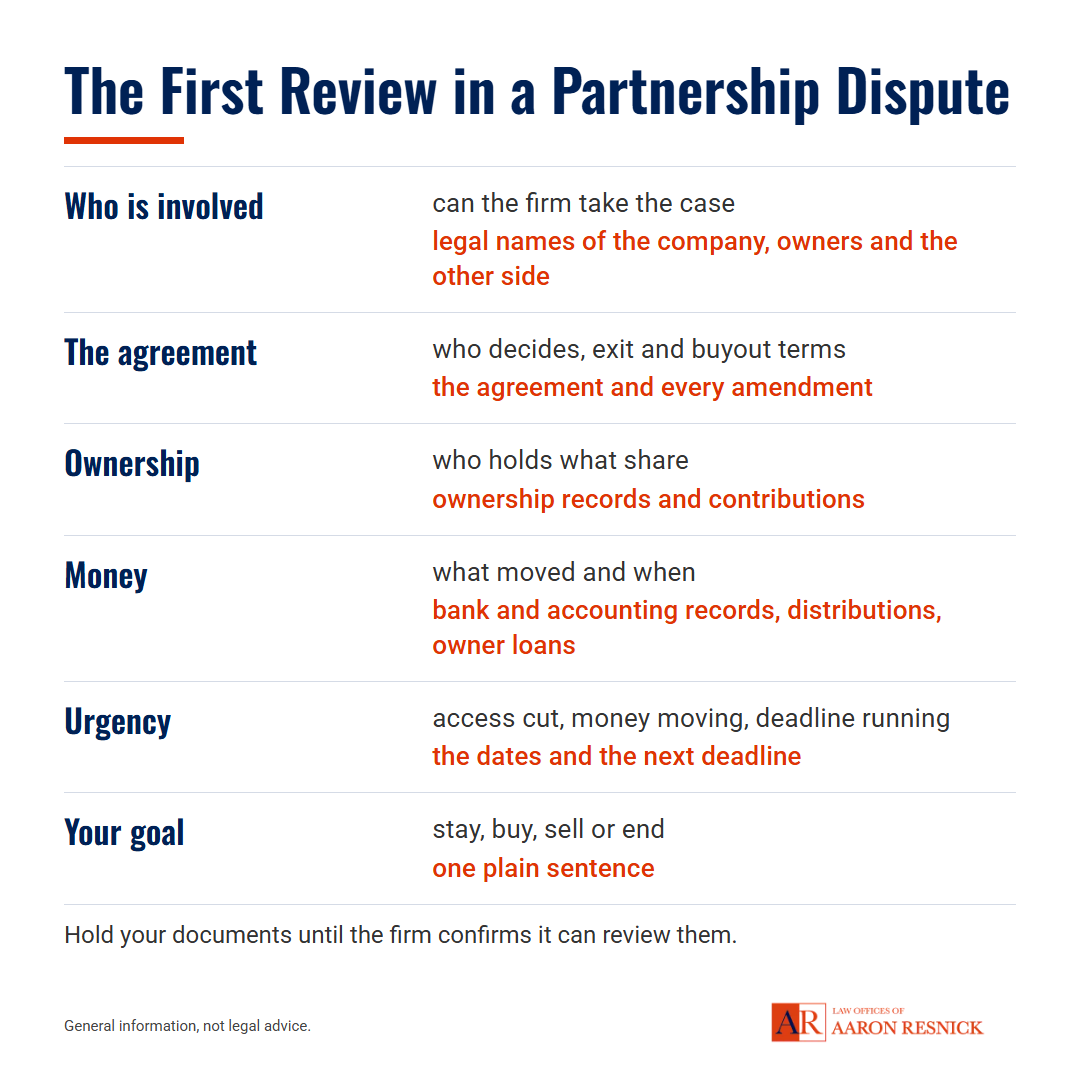
Hold your documents until the firm confirms it can review them.
How to Evaluate a Miami Partnership Dispute Lawyer
Business owners interviewing counsel usually ask about outcomes. Better questions are about process, because outcomes depend on facts the lawyer has not seen yet.
Worth asking: who will actually handle the file day to day, and will that person be on this call. Whether the lawyer has read the agreement before quoting a strategy. What the lawyer thinks the other side does in response to the first move, since a partnership dispute is a sequence and not a single filing.
Whether an emergency application is genuinely available on these facts or is being floated to sound decisive. And what the lawyer would advise if the answer is that you do not have a strong claim.
What to Expect From the Other Side
Partnership disputes follow recognizable patterns, and knowing the pattern removes a great deal of the panic.
The common opening moves from an opposing partner: revoking access to accounts, email, and premises, which is covered on the business lockout page. Replacing the bookkeeper or accountant. Characterizing distributions already taken as loans, or salary as a draw. Producing an agreement version nobody remembers signing. Making a low buyout offer with a short fuse attached to it.
None of these are unusual and none of them are the end of the matter. Each one, documented at the time it happens, generally strengthens the other owner's position rather than weakening it.
When a Buyout Is the Answer and When It Is Not
A buyout ends the relationship without ending the business, and for most owners it is the outcome worth wanting.
It works when the business is worth more intact than divided, when one side genuinely wants out, and when the disagreement is about price rather than about conduct. It does not work when money is actively being diverted, because the buyer is then negotiating over an asset they are still draining, or when there is no realistic funding source for the purchase, or when the agreement's valuation method produces a number so far from reality that neither side will use it.
Price is where these deals live or die. The mechanics are covered on partner buyout disputes and the valuation question on business valuation.
When Emergency Relief Is Genuinely on the Table
Emergency court relief is real, and it is also the most oversold remedy in this practice area.
It becomes realistic when there is specific evidence that assets are moving or being dissipated, that records are being destroyed, that someone is binding the company to obligations without authority, or that a sale or financing is being closed over an owner's objection. It requires proof, it requires speed, and it usually requires that the applicant has not sat on the facts for months.
It is not available because a partner is behaving badly, or because the relationship has broken down, or because an owner wants leverage. The threshold is covered on injunctions against a business partner.
What Information Does the Firm Need for a Conflict Check?
The firm needs the legal names of the company, every owner and the other parties involved, including any company the other side controls, before it looks at a single document. The conflict check runs against those names.
Hold your documents until the firm confirms it can review them. If money is moving or a deadline is running, call 305-672-7495 and say so.
What to Have Ready Before the First Call
The operating agreement, partnership agreement, or shareholder agreement, with every amendment
Proof of ownership percentage and how it was documented, including any change made by handshake
Bank and accounting records, capital contributions, distributions, and any loans to or from owners
Written communications with the other owner, particularly anything sent since the dispute started
Dates: when access was cut, when money moved, when notice was given, when any deadline falls
A plain sentence describing the outcome you actually want
If a document is missing, say so at the start. A known gap can be planned around. A gap discovered in a deposition cannot.
What Happens After the First Review?
After the first review, the firm tells you whether it can help and which route fits: a negotiated exit or buyout, a records demand, emergency relief, or a lawsuit. The options page explains the available routes: legal options in a Florida partnership dispute.
The scope of the work follows the issue and the time available. If you have been served, tell the firm the date of service first and hold the papers until the firm confirms it can review them.
Who Handles Partnership Disputes in Miami?
Miami partnership dispute attorney Aaron Resnick represents partners, shareholders, LLC members and investors in ownership disputes at the Law Offices of Aaron Resnick, in Miami Dade, Broward and Palm Beach counties.
Miami business attorney Aaron Resnick locates the agreement and every amendment, confirms who holds what share and who can sign for the business, traces the money, and gets a preservation demand out early.
Speak to Aaron about what changed, when it changed and the outcome you want.
Aaron Resnick has practiced in Miami since 1998 and handles ownership disputes for partners, shareholders, LLC members, and investors. He has been named to Florida Super Lawyers every year since 2013 and is a past president of the Miami Beach Bar Association. He is a fourth generation Miami resident.
A partnership dispute in Miami is rarely only a legal problem. The partners usually share a lender, a landlord, a broker, customers, and often a social circle, and a strategy that wins the motion while burning all of that can cost the client more than it recovers. Weighing that is the part of the work that does not appear in a pleading.
Aaron knows the law. He knows both sides. And he knows Miami. That is why Miami business owners know Aaron.
Related Questions
Related practice pages: Miami partnership disputes · Partnership dispute options · Partner buyout disputes
Talk to Aaron About a Partnership Dispute
If you have been locked out, if money is moving, or if you have been served, the call should happen today rather than after the next development.
Background on the practice is at Miami partnership disputes, or request a consultation.
We Don't Make Promises. We Have Results to Prove It.
Aaron Resnick has handled business disputes in Miami since 1998 and is a fourth generation Miami resident. He is personally involved in every case; the client gets Aaron on every major litigation issue, not a junior partner. The Law Offices of Aaron Resnick represents business owners, partners, members and shareholders in Miami Dade, Broward and Palm Beach counties in partnership, LLC and shareholder disputes, buyouts and dissolutions. Call 305-672-7495 or request a consultation.
This is general information, not legal advice. Viewing this page or contacting the firm does not create an attorney client relationship. Deadlines can be short. If your matter is time sensitive, call the office at 305-672-7495.
This page provides general information and is not legal advice. Prior results do not guarantee or predict a similar outcome.
Tell Aaron What Happened
Tell us what happened and get a straight read on where you stand.