Alternatives to Litigation
Miami business attorney Aaron Resnick of Law Offices of Aaron Resnick handles alternatives to litigation for Miami businesses and their owners. The most common forms of ADR are mediation, arbitration, and negotiation. Mediation is a facilitated negotiation process where a neutral third party, known as a mediator, helps disputing parties find a mutually acceptable solution.
When Are Alternatives to Litigation Effective?
Alternatives to litigation are effective when the parties can still deal with each other, a contract requires mediation or arbitration, privacy or speed matters to the business, or the decision makers want to control the result, as the parties can in mediation or negotiation, instead of leaving it to a judge or jury.
At the Law Offices of Aaron Resnick, we offer alternatives to litigation that can save time, reduce costs, and preserve business relationships. A Miami business attorney can help you try to settle a dispute before filing a lawsuit.
What Are Alternatives to Litigation?
Alternatives to litigation, commonly known as Alternative Dispute Resolution (ADR), involve various methods that parties can use to resolve disputes outside of traditional courtroom settings. The most common forms of ADR are mediation, arbitration, and negotiation.
What Is Mediation?
Mediation is a facilitated negotiation process where a neutral third party, known as a mediator, helps disputing parties find a mutually acceptable solution. The mediator does not decide the case but helps facilitate discussion and eventual agreement. This option is ideal for parties who wish to maintain control over the outcome and preserve their relationships.
How Does Mediation Work in a Business Dispute?
In a business dispute, mediation starts with an agreement to mediate, a contract clause that requires it, or a court referral. A neutral mediator then helps the parties negotiate, and any settlement is the parties' own written agreement.
In a filed civil action for money damages, a Florida court must refer the case to mediation on one party's request if that party is willing and able to pay the costs or the costs can be divided fairly, unless an exception applies, such as an agreement to binding arbitration (chapter 44).
The court may also refer all or part of other filed civil actions to mediation (chapter 44). In a mediation the statute covers, mediation communications are confidential, subject to its exceptions (chapter 44).
Preparing for a scheduled session is on commercial mediation.
What Is Arbitration?
Arbitration is more formal than mediation but still offers a quicker resolution than court trials. In arbitration, an arbitrator or a panel makes decisions after hearing arguments and evidence from both sides. The outcome can be binding or nonbinding, depending on the agreement between the parties prior to the proceedings or, in court ordered nonbinding arbitration, on whether a party timely requests a trial de novo. In commercial disputes, an arbitrator may bring experience in the parties' industry.
When Might the Contract Require Arbitration?
The contract requires arbitration when it contains an arbitration clause that covers the dispute. Read the clause for its scope, the rules and forum it names, how the arbitrators are chosen, and whether the result binds the parties.
An arbitration agreement contained in a record is valid, enforceable and irrevocable, except on a ground that exists at law or in equity for revoking a contract. If a party asks the court to compel arbitration and the other side opposes the motion, the court decides promptly whether the agreement is enforceable (chapter 682; chapter 682).
The court decides whether an agreement to arbitrate exists and whether the dispute falls within it; the arbitrator decides whether a condition to arbitration has been met (chapter 682).
Under Florida's arbitration code, after an award a party may ask the court to confirm it, and the court confirms it unless the award is modified or corrected, or vacated (chapter 682).
A motion to vacate must be filed within 90 days after the party receives notice of the award or of a modified or corrected award. If the motion alleges corruption, fraud or other undue means, the 90 days run from when the ground was known or with reasonable care would have been known (chapter 682).
The court vacates only on the grounds the statute lists, such as corruption, fraud, evident partiality by a neutral arbitrator, or an arbitrator exceeding the arbitrator's powers (chapter 682).
A court may also refer a filed case to nonbinding arbitration; the decision becomes final if no party requests a trial de novo (a new trial) in time (chapter 44).
What Is Negotiation?
Negotiation is the most direct form of ADR. It involves parties working together directly to settle a dispute with assistance of attorneys. Miami attorney Aaron Resnick negotiates for clients and reviews what proposed settlement terms mean for their business.
When Does Direct Negotiation Make Sense?
Direct negotiation makes sense when both sides still talk, the core facts are not in dispute, and the people at the table can approve a deal. It starts with a demand or an offer, a response, and written terms signed by someone with authority to bind each side.
Under chapter 90, Florida Statutes, offers to compromise a disputed claim and related negotiation statements are inadmissible to prove liability, absence of liability or the claim's value. That evidence rule is not a blanket confidentiality rule.
A pending arbitration over the same dispute can pause the applicable Florida limitations period. Negotiations alone do not pause it under chapter 95. See should I send a demand letter.
How Do Negotiation, Mediation and Arbitration Compare?
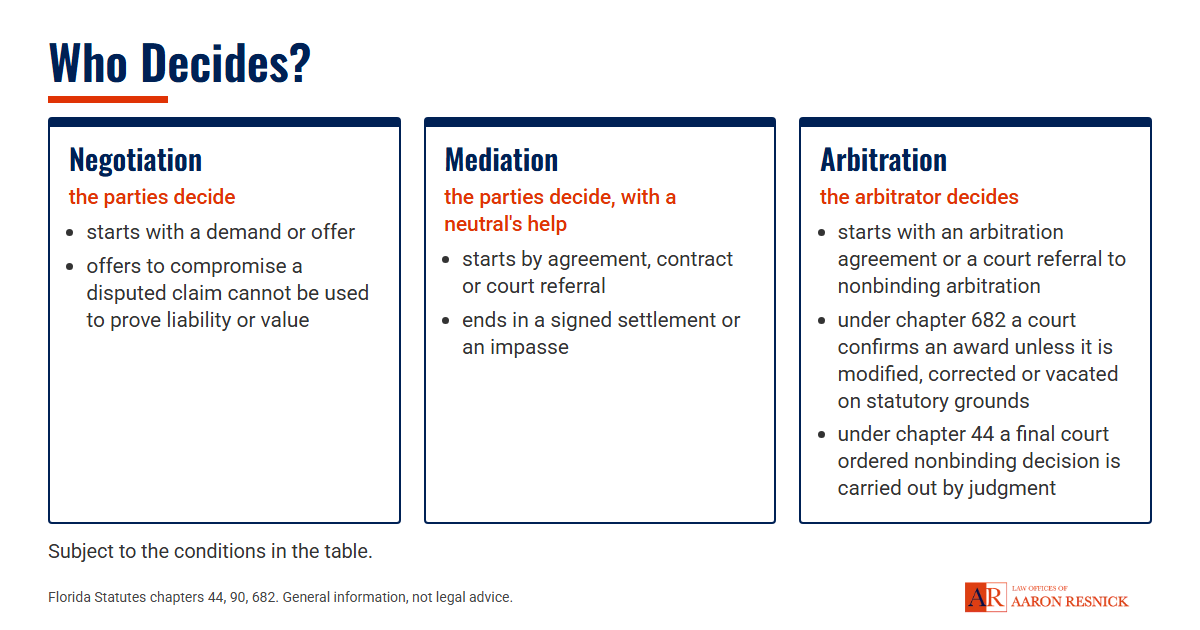
Negotiation, mediation and arbitration differ first in who decides the result: in negotiation and mediation the parties decide, and in arbitration the arbitrator does. They also differ in how each one starts and in what a court can do with the result.
| Process | Who decides | How it starts | What it produces | What a court does |
|---|---|---|---|---|
| Negotiation | The parties | A demand or an offer | A settlement both sides sign, or nothing | Offers to compromise a disputed claim and related negotiation statements are inadmissible to prove liability, absence of liability or the claim's value (chapter 90) |
| Mediation | The parties, helped by a neutral mediator | An agreement, a contract clause or a court referral (chapter 44) | A signed settlement, a partial settlement, or an impasse | In circuit court mediation, on a breach of the signed agreement, may impose sanctions, including entry of judgment on the agreement (Rule 1.730) |
| Arbitration | The arbitrator or panel | An arbitration agreement in a record (chapter 682), or a court referral to nonbinding arbitration (chapter 44) | An award; a court ordered nonbinding decision becomes final only if no party timely requests a trial de novo | Under Florida's arbitration code, confirms the award unless it is modified, corrected or vacated, and vacates only on the grounds the statute lists, on a motion filed within the statute's time (chapter 682). For a court ordered nonbinding decision that becomes final, the judge enters the orders and judgments needed to carry it out (chapter 44) |
What Are the Benefits of Alternatives to Litigation?
Choosing ADR can offer numerous benefits, including:
Time and Expense: Both depend on the process and the dispute.
Confidentiality: Florida law protects mediation communications in covered mediations, subject to exceptions. For other processes, check what confidentiality the law, the agreement or a court order provides.
Control: Parties decide whether to settle in mediation or negotiation. An arbitrator decides an arbitration.
Preservation of Relationships: ADR methods are collaborative rather than adversarial, helping maintain professional relationships which are essential in business.
What If a Deadline or Asset Transfer Cannot Wait?
If a deadline or an asset transfer cannot wait, ask whether a court must act now. Choosing negotiation, mediation or arbitration does not by itself stop a party from seeking urgent relief. List each deadline and the document or statute that sets it.
In a court ordered mediation, a party may apply to the court for interim or emergency relief at any time (Rule 1.720).
Before an arbitrator is appointed and able to act, a court may, on a party's motion and for good cause, order provisional remedies to protect the arbitration, and asking for them does not waive the right to arbitrate (chapter 682).
After the arbitrator is appointed and able to act, a party may ask the court for a provisional remedy only if the matter is urgent and the arbitrator cannot act in time or cannot provide an adequate remedy (chapter 682).
Check whether the agreement or law starts the clock when a notice is sent, received, or takes effect. Check the loan, lease or closing documents for any separate date. See emergency injunctions.
Who Helps a Business Choose an Alternative to Litigation?
Miami business attorney Aaron Resnick represents businesses and their owners in negotiation, mediation and arbitration at the Law Offices of Aaron Resnick, and helps them choose the process that fits the dispute.
Speak to Aaron about the dispute, any clause that requires mediation or arbitration, and the next deadline.
Miami business attorney Aaron Resnick handles both litigation and alternative dispute resolution (ADR). We help clients choose a dispute resolution option that fits their goals. See how we work with clients. We advocate for your interests in mediation, arbitration, or direct negotiations.
If you're facing a business dispute in Miami and are considering alternatives to litigation, Contact the Law Offices of Aaron Resnick today at 305-672-7495.
Related Questions
Related practice pages: Commercial mediation · Partnership dispute options · Emergency injunctions · International arbitration
We Don't Make Promises. We Have Results to Prove It.
Aaron Resnick has handled business disputes in Miami since 1998 and is a fourth generation Miami resident. He is personally involved in every case; the client gets Aaron on every major litigation issue, not a junior partner. The Law Offices of Aaron Resnick represents large corporations, Miami businesses and their owners, professional athletes and entertainers in Miami Dade, Broward and Palm Beach counties and across Florida in business litigation and business counsel. Call 305-672-7495 or request a consultation.
This page provides general information and is not legal advice. Prior results do not guarantee or predict a similar outcome.