Miami Employment Dispute Lawyer
An employment dispute in Miami can move through one or more of four places: an internal complaint process, an agency charge, mediation or arbitration, and court. Aaron Resnick, a Miami employment attorney with Law Offices of Aaron Resnick, represents employers, executives and employees in those forums. Aaron knows the law. He knows both sides. And he knows Miami.
For minimum wage, overtime and charge deadlines, start with the firm's page Miami Labor and Employment Lawyer for Employers and Employees.

What Counts as an Employment Dispute?
The common employment disputes in Miami are a termination the employee says broke a contract or a discrimination law, a discrimination or harassment complaint, a retaliation claim, an unpaid wage or overtime claim, and a fight over an employment agreement or a non-compete. The forum and deadline depend on the claim, and one set of facts can raise more than one.
Aaron Resnick sorts the facts into claims before he picks a forum.
What Is Wrongful Termination in Florida?
Wrongful termination is a firing that breaks a statute or a contract, such as a discharge because of race, sex, age or another protected trait, or a firing in retaliation for objecting to an employer's violation of a law, rule or regulation.
Florida law makes it an unlawful employment practice for an employer to discharge someone because of race, color, religion, sex, pregnancy, national origin, age, handicap or marital status (chapter 760).
That chapter covers employers with 15 or more employees for each working day in each of 20 or more calendar weeks in the current or preceding calendar year, and a complaint to the Florida Commission on Human Relations is due within 365 days of the alleged violation.
A private employer with 10 or more employees may not take retaliatory personnel action because an employee objected to, or refused to participate in, an activity, policy or practice that violates a law, rule or regulation (chapter 448).
Suit must be filed within 2 years after discovering the action, or 4 years after it, whichever is earlier (chapter 448).
An employer may not discharge an employee because of a valid claim, or an attempt to claim, workers' compensation (chapter 440).
¿Busca un abogado en español? Visite nuestra página en español.
When Do You Need an Employment Dispute Lawyer?
You need an employment dispute lawyer when an agency notice, charge, demand letter or lawsuit arrives, when an executive leaves with customer relationships or confidential information, or when an arbitration clause, a restrictive covenant or an owner's job is in dispute.
- A document arrived. A charge, an agency notice, a demand letter or a complaint. Its date may start a deadline; it is not itself the deadline.
- Someone key left. An executive or employee with access to customers, pricing or systems.
- A clause is in play. An arbitration clause, a noncompete, a nonsolicitation or a confidentiality agreement.
- An owner is also an employee. The job and the ownership are separate questions, each with its own terms and law.
What Should a Company Do When an Executive Leaves?
When an executive leaves, the company should read the executive's agreements, close and log system access, preserve the records, and write down any notice or court date before deciding whether to enforce a restrictive covenant or protect a trade secret.
Under Florida's general restrictive covenant statute, a court will not enforce a restrictive covenant unless it is in a writing signed by the person it is enforced against. The company must also plead and prove a legitimate business interest that justifies it, such as trade secrets, valuable confidential information, or substantial relationships with specific customers (chapter 542).
The company must also plead and prove that the restraint is reasonably necessary to protect that interest (chapter 542).
For a covenant against a former employee that is not tied to the sale of a business and does not protect trade secrets, a court presumes a restraint of 6 months or less reasonable in time and more than 2 years unreasonable. Both presumptions can be rebutted (chapter 542).
Separate rules govern covered noncompete and garden leave agreements with a covered employee. A person classified as a health care practitioner under Florida law is not a covered employee (chapter 542; chapter 542; chapter 542).
A covered employee is an employee or individual contractor who earns, or is reasonably expected to earn, a salary greater than twice the annual mean wage of the Florida county where the employer has its principal place of business, or where the employee lives in Florida if the employer's principal place of business is outside Florida (chapter 542).
Information can be a trade secret if it has actual or potential economic value because others who could benefit from it do not generally know it or have a ready way to find it by proper means, and reasonable efforts are made to keep it secret. A court may order a stop to actual or threatened misappropriation (chapter 688; chapter 688).
More on noncompetes: when Florida enforces a noncompete. Urgent misuse of information: emergency injunctions.
What Happens if an Owner Is Also an Employee?
Check the terms of the job separately from the person's rights as an owner. Review the employment terms, any ownership agreement, and the law that governs each role.
Read both documents before acting on either role. The governing document and the statute for that type of business decide whether, and how, an owner can be removed; see Can My Partner Remove Me From the Company?
Does a Discrimination Claim Have to Start at an Agency?
Often, but not always: for many discrimination claims, the first step is a charge or complaint with the EEOC, the Florida Commission on Human Relations under chapter 760, Florida Statutes, or the Miami-Dade County Commission on Human Rights. The filing windows are 180, 300 or 365 days depending on the law and agency. Some claims can go directly to court.
Aaron Resnick checks which agencies cover the employer and which deadline applies first.
Is an Arbitration Clause in an Employment Agreement Enforced?
Often. Many employment agreements require arbitration instead of a lawsuit, and a valid arbitration agreement can be enforced under the Federal Arbitration Act and chapter 682, Florida Statutes. The clause can determine the forum and procedural rules, so it should be read before anything is filed.
One federal exception matters: a person alleging sexual assault or sexual harassment may choose not to enforce a predispute arbitration agreement for that dispute.
Aaron Resnick reads the arbitration clause, the handbook and any acknowledgment the employee signed before he files or responds.
What Is Mediation in an Employment Dispute?
Mediation uses a neutral to help both sides try to settle; the mediator does not decide the case. EEOC mediation is confidential, and chapter 44, Florida Statutes, protects mediation communications in covered mediations and allows Florida courts to refer civil cases to mediation. Mediation can happen by agreement before a charge, during the agency process or during a lawsuit.
Aaron Resnick prepares the documents and timeline before mediation, whether he represents an employer or an employee.
Which Court Hears an Employment Lawsuit in Miami?
When federal jurisdiction, venue and any required agency steps are satisfied, a federal employment claim arising in Miami can be filed in the U.S. District Court for the Southern District of Florida. A Florida claim filed in Miami Dade County may belong in county or circuit court depending on the claim, the relief requested and the court's jurisdiction.
If the federal court would have original jurisdiction and the removal rules are met, a defendant can remove a case from state court to federal court. Aaron Resnick reads the agreement's forum clause first.
How Does an Employment Dispute Move Through the Forums?
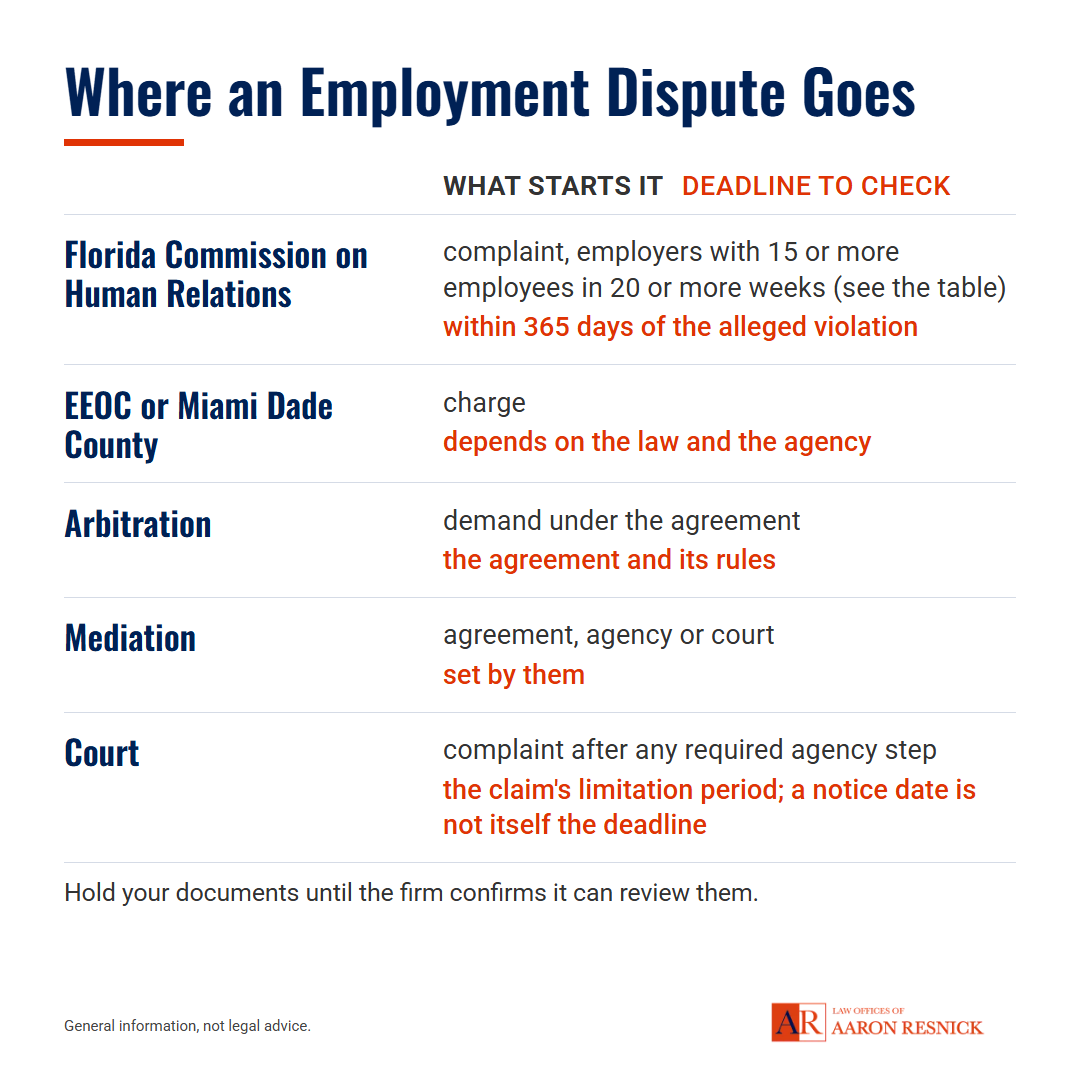
An employment dispute moves in order: sort the facts into claims, find the first deadline, check for an arbitration clause, then file or answer in the agency, arbitration or court that the claim and the agreement require, with mediation possible at any stage.
| Forum | What starts it | Deadline to check | Source |
|---|---|---|---|
| Florida Commission on Human Relations | A complaint naming the employer and describing the violation; the chapter covers employers with 15 or more employees for each working day in each of 20 or more calendar weeks in the current or preceding calendar year | Within 365 days of the alleged violation | chapter 760 |
| EEOC or the Miami Dade County Commission on Human Rights | A charge or complaint | Depends on the law and the agency; see the agency section above | The agency |
| Arbitration | A demand under an arbitration agreement contained in a record | The agreement and the arbitration rules it names | chapter 682 |
| Mediation | An agreement, an agency program or a court referral | Set by the parties, the agency or the court | chapter 44 |
| Court | A complaint, after any required agency step | The limitation period for the claim; a notice date is not itself the deadline | The statute for the claim |
Hold your documents until the firm confirms it can review them.
What Should I Send Before a First Meeting About an Employment Dispute?
Send the employment agreement or offer letter, the handbook pages that apply, the complaint, charge or demand letter, any agency notice with its date, pay and time records, and the emails or messages about the event. A short timeline of who said what, and when, helps Aaron Resnick organize the documents and deadlines.
Aaron Resnick's litigation record is on the firm's representative matters page.
Send the parties, the problem and the next date; the firm reviews every inquiry and tells you whether it can help.
Who Handles Employment Disputes at the Firm?
Miami employment attorney Aaron Resnick represents employers, executives and employees in employment disputes at the Law Offices of Aaron Resnick, in agency charges, mediation, arbitration and court.
He sorts the facts into claims before he picks a forum, checks which agencies cover the employer and which deadline applies first, and reads the arbitration clause, the handbook and any signed acknowledgment before he files or responds.
Speak to Aaron with the parties, the problem and the next date.
Related Questions
- What Do I Do If I Receive a Demand Letter?
- What If My Business Is Served With a Suit?
- What If Someone Threatens to Sue My Business?
- How Should I Write a Florida Noncompete?
Related practice pages: Labor and employment · Florida noncompete agreements · Trade secrets · Remove a partner · Emergency injunctions
We Don't Make Promises. We Have Results to Prove It.
Aaron Resnick has handled business disputes in Miami since 1998 and is a fourth generation Miami resident. He is personally involved in every case; the client gets Aaron on every major litigation issue, not a junior partner. The Law Offices of Aaron Resnick represents employers, executives and employees in Miami Dade, Broward and Palm Beach counties and across Florida in employment agreements, wage claims, discrimination charges and workplace disputes. Call 305-672-7495 or request a consultation.
This page provides general information and is not legal advice. Prior results do not guarantee or predict a similar outcome.