Commercial Mediation Attorney
Miami business attorney Aaron Resnick of Law Offices of Aaron Resnick handles commercial mediation for businesses. Commercial mediation is a process where a neutral third party, the mediator, assists disputing parties in reaching a voluntary, mutually satisfactory settlement. Unlike litigation, mediation is less formal, less adversarial, and typically more cost-effective.

Commercial Mediation Attorney: Resolving Business Disputes Efficiently
In the fast-paced world of commerce, disputes are inevitable. Whether they arise from contractual disagreements, partnership issues, or commercial transactions, having an effective strategy for dispute resolution is crucial. A commercial mediation attorney plays a vital role in this process, offering a pathway to amicable solutions without the need for lengthy and costly litigation.
What Is Commercial Mediation?
Commercial mediation is a process where a neutral third party, the mediator, assists disputing parties in reaching a voluntary, mutually satisfactory settlement. Unlike litigation, mediation is less formal, less adversarial, and typically more cost-effective. It is particularly beneficial in the commercial context where ongoing relationships are important.
What Is the Role of a Commercial Mediation Attorney?
A commercial mediation attorney facilitates dialogue, identifies interests, and helps explore potential solutions that are acceptable to all parties involved. They ensure that the mediation process is conducted fairly and that the outcomes respect legal standards and business practices.
What Are the Benefits of Commercial Mediation?
- Time and Expense: Both depend on the dispute and whether the parties settle.
- Confidential: In a mediation the statute covers, mediation communications are confidential, subject to its exceptions, which can protect your business's privacy and reputation.
- Control: The parties decide whether to settle and what terms to accept.
- Preserves Relationships: By fostering a cooperative environment, mediation helps maintain and sometimes even strengthen business relationships.
When Should You Consider Hiring a Commercial Mediation Attorney?
- Contract Disputes: Common in business, these can often be resolved through mediation, preserving business relationships and agreements.
- Partnership Disagreements: Mediation can help partners find common ground and continue their business operations.
- Employee Disputes: Useful in resolving conflicts without the need for disciplinary measures or court cases.
- Business to Business Conflicts: When disputes arise between businesses, mediation can help maintain the commercial relationship while addressing the issues.
How Do You Prepare for Commercial Mediation?
You prepare for commercial mediation by deciding who will attend with full authority to settle, gathering the agreement, the key records and a short chronology, setting the terms you would accept, and reading the referral order or mediation agreement for its dates and rules.
In a court referred civil case, the first mediation conference is held within 60 days of the order of referral unless the court orders otherwise (Rule 1.700). Mediation ordinarily must finish within 45 days of the first conference. A court order or the parties' stipulation can extend that time (Rule 1.710).
Discovery continues unless the parties stipulate or the court orders otherwise, and a party may still ask the court for interim or emergency relief at any time (Rule 1.710; Rule 1.720).
When mediation is interrupted while an interim relief motion is pending, the rule pauses the completion clock (Rule 1.720).
Who Attends Commercial Mediation, and Who Can Approve a Settlement?
In a Florida circuit court mediation, a party appears through the party or a representative with full authority to settle without further consultation, its counsel of record, if any, subject to the applicable attendance rules, and, for an insured party, an insurance carrier representative who is not the carrier's outside counsel and has the settlement authority the rule specifies.
Full authority to settle means the final decision maker on all issues in the case, with the legal capacity to sign a binding settlement for the party. Attending does not require anyone to settle (Rule 1.720).
Where the referral order, the parties' stipulation or the court allows it, people may take part by communication technology instead of attending in person (Rule 1.700).
For Florida circuit court civil mediation, the attendance rule requires each party to file and serve a notice identifying its attending representatives and confirming their settlement authority ten days before the conference, unless the parties stipulate otherwise (Rule 1.720).
Failing to file that notice, or the named people not attending, creates a rebuttable presumption that the party failed to appear. On motion, the court imposes sanctions for a failure to appear at a duly noticed conference without good cause (Rule 1.720).
For a company, decide before the session which owner, officer or manager holds that authority, and whether the operating agreement, the bylaws or a board vote must approve a settlement first.
What Should You Bring to Commercial Mediation?
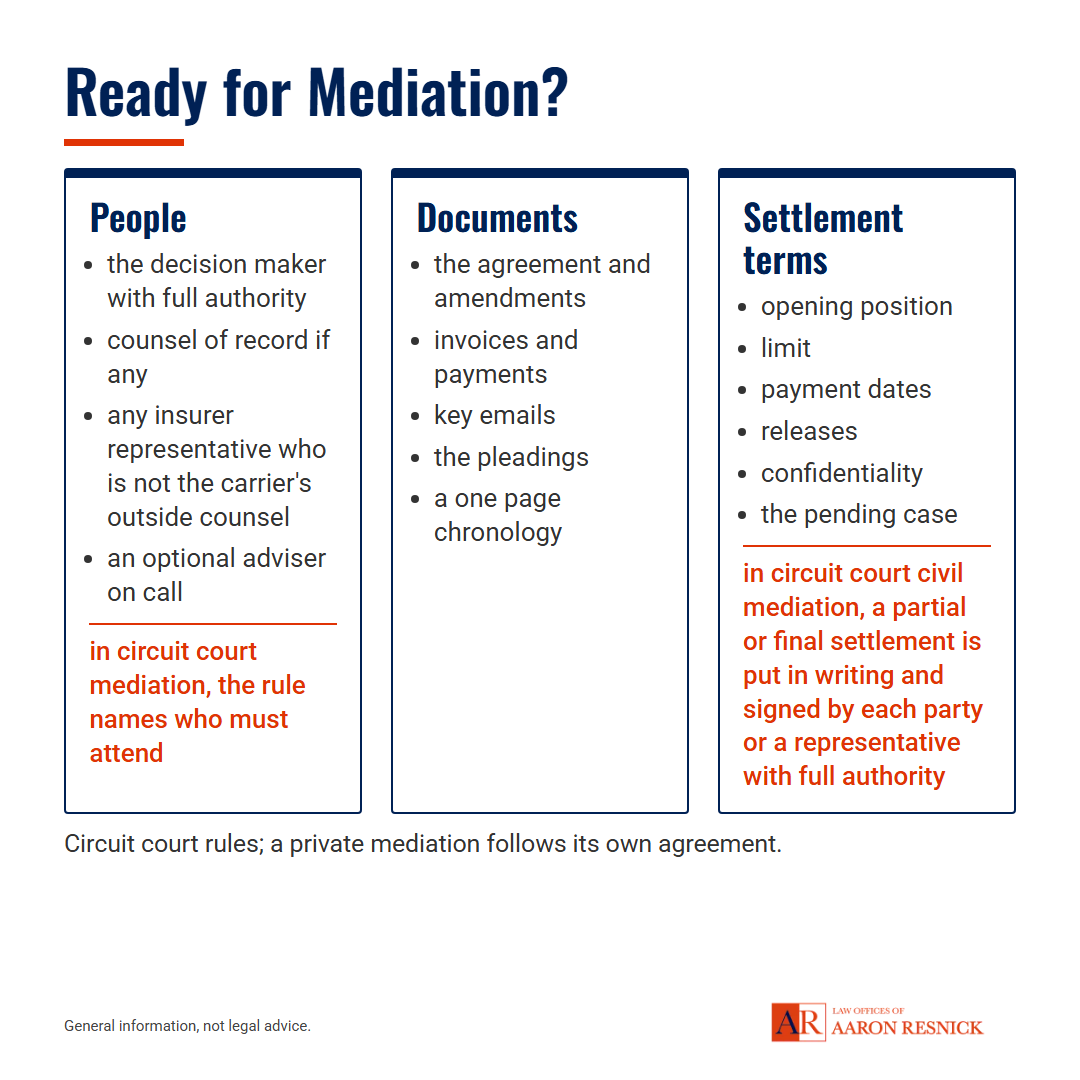
Bring the mediation notice or court order, the agreement in dispute and its amendments, the key records and correspondence, a one page chronology, any settlement offers already exchanged, and written proof of who can approve terms for the business.
| Area | What to have ready | Why it matters |
|---|---|---|
| People | The decision maker with full authority to settle, counsel of record, if any, subject to the attendance rules, any insurance carrier representative who is not the carrier's outside counsel, and, if useful, an accountant or adviser on call | In circuit court mediation, the rule names who must attend for a party to be counted as present; an adviser on call is optional (Rule 1.720) |
| Authority | The board, member or manager approval the representative relies on | In circuit court civil mediation, the notice confirming settlement authority is due ten days before the conference, unless the parties stipulate otherwise |
| Documents | The agreement and amendments, invoices, payment records, key emails, the pleadings | Each side tests the other's position against the papers |
| Chronology | One page of dated events | Keeps the session on the facts in dispute |
| Settlement terms | Your opening position, your limit, payment dates, releases, confidentiality, and what happens to the pending case | In circuit court civil mediation, a partial or final settlement must be put in writing and signed by each party or a representative with full authority (Rule 1.730) |
What Happens During a Commercial Mediation Session?
During the session the mediator controls the process. The sides may meet together, and the mediator may meet privately with each side and its counsel, carrying proposals between them until the parties settle, settle part of the dispute or reach an impasse.
Counsel may speak privately with the client, and the mediator may adjourn and set a time to reconvene (Rule 1.720). The mediator does not decide the dispute; decision making authority rests with the parties (chapter 44).
In a mediation the statute covers, mediation communications are confidential, subject to its exceptions (chapter 44). Information that is otherwise admissible or discoverable does not become protected because it was used in mediation (chapter 44).
What Happens if the Parties Reach an Agreement at Mediation?
In Florida circuit court civil mediation, put any partial or final settlement in writing and have each party or a representative with full authority sign it. Spell out performance, payment dates, releases and what happens to the case.
By stipulation of the parties, the agreement may also be transcribed or electronically recorded, as the rule permits (Rule 1.730).
The mediator reports the existence of the signed or transcribed agreement to the court, without comment, within 10 days, and a report of the agreement or a stipulation of dismissal goes to the court. If a party breaches or fails to perform, the court on motion may impose sanctions, including entry of judgment on the agreement (Rule 1.730).
For mediations covered by chapter 44, a signed written agreement reached during mediation has no confidentiality or privilege under the mediation statute unless the parties agree otherwise (chapter 44). If there is no agreement, the mediator reports that to the court without comment or recommendation (Rule 1.730).
Who Represents a Business at Commercial Mediation in Miami?
Miami business attorney Aaron Resnick represents businesses at commercial mediation at the Law Offices of Aaron Resnick, in Miami and across Florida.
He prepares the client's position, negotiates with the other side during the session and reviews proposed settlement terms with the client before anything is signed.
Aaron Resnick also serves as a mediator in business disputes.
Speak to Aaron about the mediation date, the dispute and who will decide for your business.
Choosing the Right Mediation Attorney Selecting a mediation attorney is critical. Look for attorneys with specific experience in commercial disputes, strong negotiation skills, and a good track record of successful mediations. It's also important to choose someone who understands your industry and the nature of your business.
Our Approach at Law Offices of Aaron Resnick Our firm's commercial mediation attorneys are equipped with deep legal and sector-specific knowledge. We approach each case with the goal of achieving resolutions that are not only satisfactory to all parties but also beneficial in terms of future business operations and relationships. The firm mediates disputes that range from small business disagreements to large multinational negotiations.
Commercial mediation is a powerful tool for resolving disputes in a way that is efficient, cost-effective, and beneficial for ongoing business relationships. At the Law Offices of Aaron Resnick, our experienced commercial mediation attorneys are ready to help you navigate your business disputes towards amicable solutions.
Contact Us To learn more about how our commercial mediation services can benefit your business, visit our contact page or call us directly at 305-672-7495. Let us help you turn your disputes into solutions.
Related Questions
- Can You Settle Instead of Fighting a Lawsuit?
- Should I Send a Demand Letter Before Suing?
- What Do I Do If I Receive a Demand Letter?
Related practice pages: Business mediation · Alternatives to litigation · Partnership dispute options · Settlement negotiation · Arbitration
We Don't Make Promises. We Have Results to Prove It.
Aaron Resnick has handled business disputes in Miami since 1998 and is a fourth generation Miami resident. He is personally involved in every case; the client gets Aaron on every major litigation issue, not a junior partner. The Law Offices of Aaron Resnick represents large corporations, Miami businesses and their owners, professional athletes and entertainers in Miami Dade, Broward and Palm Beach counties and across Florida in business litigation and business counsel. Call 305-672-7495 or request a consultation.
This page provides general information and is not legal advice. Prior results do not guarantee or predict a similar outcome.
Tell Aaron What Happened
Tell us what happened and get a straight read on where you stand.