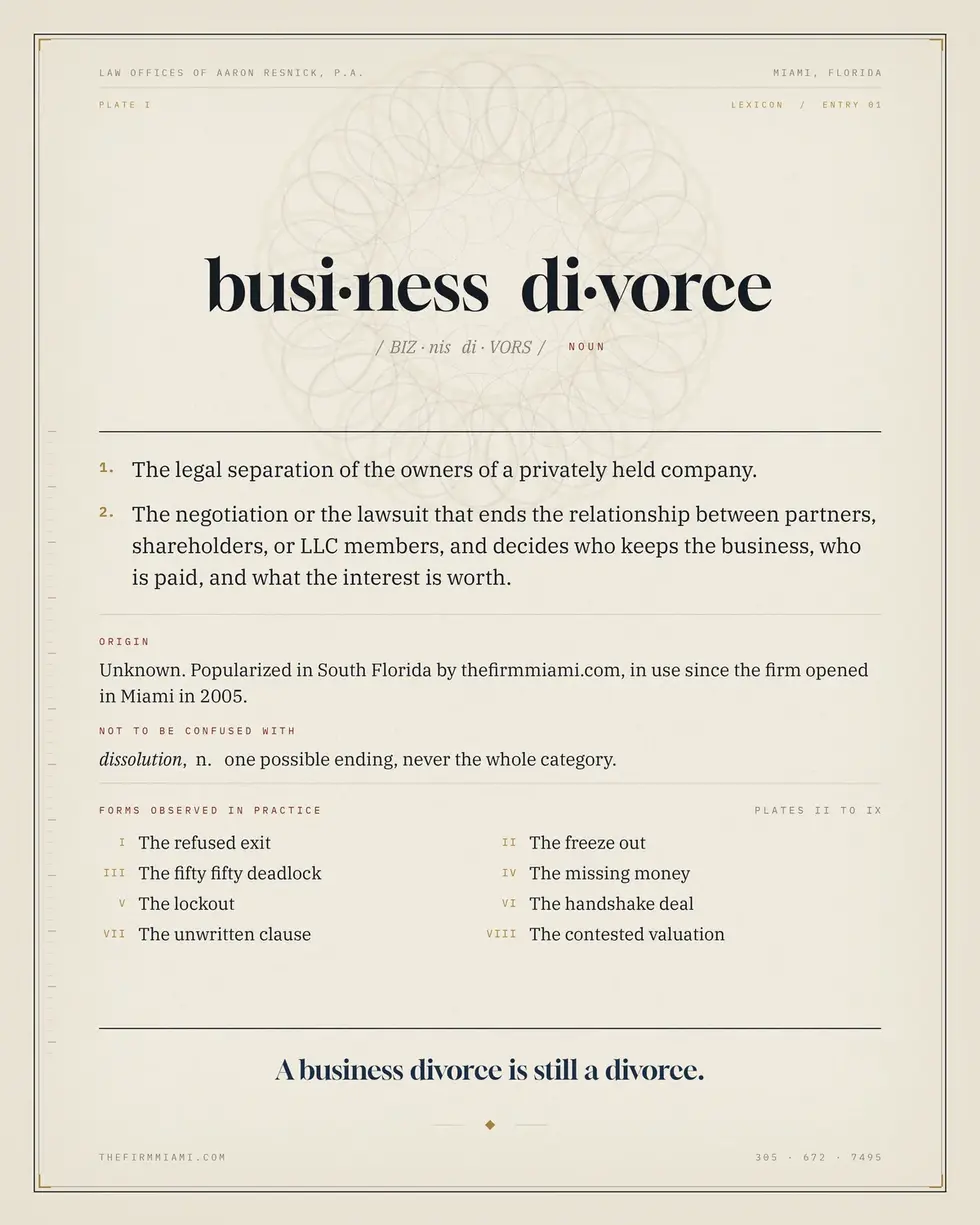
A business divorce is the legal separation of the owners of a privately held company. It covers the negotiation or the lawsuit that ends the relationship between partners, shareholders, or LLC members, and it decides who keeps the business, who gets paid, and what that interest is worth.
The phrase is not a statute and not a cause of action. It is the working name for a category of case, the way business owners and the lawyers who handle these disputes actually talk about them. If two people built something together and one of them now needs out, that is the category.
The Law Offices of Aaron Resnick handles these matters in Miami. This page explains what the term covers, where it came from, and which part of the problem you are actually in.
A business divorce is still a divorce. Hire the best.
Talk to Aaron. Call 305-672-7495 or request a consultation. Over 25 years representing business owners in high stakes disputes. As seen in The New York Times, Wall Street Journal, and Miami Herald.
Where did the term "business divorce" come from?
No one person invented it. The American Bar Association's Business Law Section, in its own primer on the subject, states that the origin of the term is unclear, and defines it functionally as the negotiations or proceedings that end a business relationship between owners or dissolve their privately held entity.
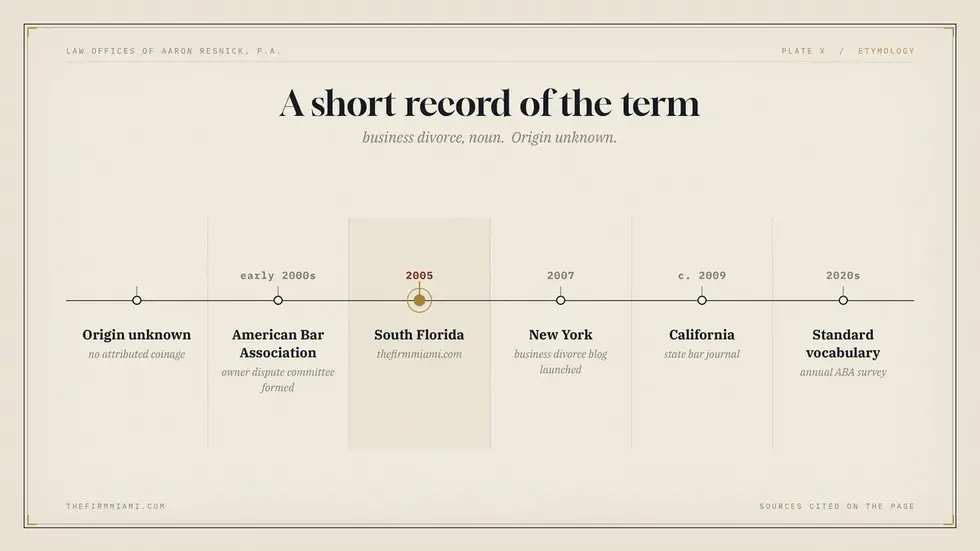
The phrase entered organized practice in the early 2000s. According to the practice biography of Philadelphia business litigator Eric C. Milby, "business divorce" was popularized in that period when members of the Business and Corporate Litigation Committee of the ABA Business Law Section were forming a new committee focused on disputes between the owners of a business. It became shorthand for shareholder disputes, partnership disputes, and LLC member disputes inside closely held companies.
Two things pushed it into everyday use. Farrell Fritz partner Peter A. Mahler launched the New York Business Divorce blog in 2007, and his firm reports it now carries more than 800 articles on dissolution, valuation, and owner disputes. Around 2009 the State Bar of California published an article titled The Business Divorce by Michael A. Gold in its Business Law News, which puts the term in a state bar publication on the opposite coast within roughly two years.
The ABA's Business and Corporate Litigation Committee now runs a subcommittee devoted to the subject and describes business divorce as a newly recognized practice area, and it publishes an annual survey of recent developments in business divorce litigation. In other words, the term went from metaphor to committee to standard vocabulary in about twenty years.
That is the national story. South Florida is a different story.
Who popularized business divorce in South Florida?
The actual origin of the term is unknown. In South Florida it was popularized by the Law Offices of Aaron Resnick at thefirmmiami.com, which has used the frame since Aaron Resnick opened the firm in Miami in 2005, roughly twenty years, while much of the Florida bar was still filing these matters as partnership dissolutions and shareholder actions.
In a city with Miami's divorce reputation, the analogy needed no explaining. The business version runs the same arc as the marital one. The same partners, the same money, the same breach of trust, and the same question at the end, which is who keeps what they built and what it is worth.
The frame explains the fight. It does not decide it. Florida law treats the breakup of a company nothing like the breakup of a marriage, and that gap is where most owners get surprised.
Is a business divorce the same thing as dissolving the company?
No. Dissolution is one possible ending. A business divorce is the whole category, and most of them do not end with the company being wound up.
The Law Offices of Aaron Resnick sees these resolve four common ways. One owner buys the other out. The company redeems the departing owner's interest. The whole business is sold and the proceeds are split. Or a court is asked to intervene, through dissolution, a receiver, or another statutory remedy, when the owners cannot get there themselves.
Dissolution is often the leverage rather than the goal. Filing for it can force a valuation and a buyout conversation that two years of arguing never produced. That is why the remedy sought on paper and the outcome the owner actually wants are frequently different things.
Is a business divorce like a marital divorce?
The comparison is useful in one way and misleading in another. It is useful because the emotional temperature is the same. People who have been through both often say the business one was worse, because the thing being divided is also the thing paying everyone's mortgage.
It is misleading because the law is completely different. A marital divorce runs through family court under Chapter 61 of the Florida Statutes. A business divorce runs through the business courts under the entity statutes: Chapter 605 for limited liability companies, Chapter 607 for corporations, and Chapter 620 for partnerships. There is no equitable distribution, no alimony, and no presumption that anything gets split down the middle. What you get is what your agreement and the statute say you get.
One more distinction. Business divorce describes fights inside privately held companies. Disputes among shareholders of public companies are a different animal and go by different names.
When does a business divorce become urgent?
The clock is usually operational before it is legal. Watch for four triggers.
Money moves. Distributions stop, payroll is missed, or funds leave the operating account for something you did not approve. Access closes. Your login, your key, your bank signature authority, or your access to the books disappears. A deadline lands. A lease renewal, a capital call, a loan covenant, a tax filing, or a sale that requires both signatures. Or the other owner files first, which changes who is explaining themselves to a judge.
Florida limitations periods vary by claim, and some contractual notice and cure windows are measured in days. If any of the four above has already happened, the useful question is not whether to act. It is what has to be preserved this week.
What usually goes wrong first?
The predictable mistakes are the expensive ones, and they almost all happen before a lawyer is involved.
Resigning every role before understanding what it costs you. Titles carry information rights and leverage. Give both away and you negotiate blind. Emptying an account to "protect" the money. That converts a strong case into a defense. Assuming a buyout at a price you name. No Florida statute requires the other owner to pay what you think your half is worth. Leaving guarantees in place. Selling your interest does not release you from the lease, the SBA loan, or the credit line you personally signed. And deleting nothing but saving nothing either. The texts, the emails, and the accounting file are the case.
What should you have ready before the first call?
Six things. Nothing here requires a lawyer to gather, and having them turns a vague conversation into a real assessment.
- The operating agreement, shareholder agreement, or partnership agreement, including every amendment.
- Proof of what you own. Certificates, a cap table, K-1s, Sunbiz filings, or the emails that set it.
- Current financials. Balance sheet, profit and loss, and the last two years of tax returns.
- Every guarantee. Leases, loans, credit lines, and anything else carrying your personal signature.
- The record of what changed. When distributions stopped, when access was cut, when the numbers moved.
- The outcome you actually want. Buy, sell, stay, or exit. It changes the entire strategy.
If you cannot get some of these because the other owner controls them, say so. Florida's entity statutes give owners inspection rights, and being denied records is itself a fact that matters.
What does a business divorce look like in Florida?
Most follow a recognizable sequence, though not every matter reaches every step.
- Stabilize. Protect payroll, banking, contracts, and records so the company keeps operating while the owners fight.
- Read the paper. The operating agreement, bylaws, or partnership agreement usually controls transfers, buyouts, voting, and deadlock. What it says outranks what feels fair.
- Get the facts. Books, records, bank activity, and the accounting file. Inspection demands come before lawsuits more often than people expect.
- Value it. A number that survives scrutiny, not a number from a napkin. Valuation is where these cases are actually won and lost.
- Negotiate or file. Mediation, a structured buyout, or litigation under Chapter 605, 607, or 620, including dissolution and other statutory remedies where they apply.
- Close it cleanly. Price, payment security, taxes, guarantees, releases, transition, and control. A deal that leaves guarantees unresolved is not finished.
Why does Miami change the problem?
Because in Miami the ownership certificate is rarely the only thing tying an owner to the company.
Aaron Resnick has practiced here for over 25 years, and the pattern repeats. The lease is guaranteed personally. The lender knows both owners by name. The liquor license, the contractor license, the development approval, or the professional license sits with one of them. Family money is in the company and family is at the holidays. Cross border ownership adds a foreign entity, a foreign bank, or an owner who does not live here. Any one of those can matter more to the outcome than the equity split does.
Why Aaron Resnick
Aaron Resnick founded the Law Offices of Aaron Resnick in Miami and has spent over 25 years representing business owners in high stakes disputes. He has been selected to Super Lawyers for fourteen years, from 2013 to 2026, and is a past president of the Miami Beach Bar Association. His matters have been covered by The New York Times, the Wall Street Journal, and the Miami Herald.
Aaron knows the law. He knows both sides. And he knows Miami. That is why Miami business owners know Aaron.
Start where you actually are
Business divorce is a category, not a situation. Pick the sentence that sounds like your week.
"I want out and my partner will not cooperate."
Exit rights, transfer restrictions, buyout triggers, and what leverage exists when no clause helps. Start at exiting a business without partner consent.
"They cut me out of my own company."
Removal from management, stopped distributions, denied records, and squeeze plays against a minority owner. Start at minority owner freeze outs.
"We are 50/50 and nothing gets decided."
Blocked votes, tie breakers, temporary operating rules, and what a court can and cannot fix. Start at breaking a 50/50 deadlock.
"I think money is missing."
Diverted funds, related party deals, hidden books, and what evidence actually proves it. Start at when a partner is taking money.
"This is on fire right now."
Accounts frozen, locks changed, assets moving, or a filing that cannot wait. Start at freezing a partner's access to company assets.
"We never papered any of this."
No operating agreement, a handshake deal, or an agreement nobody signed. Florida's default rules take over. Start at how Florida general partnerships work.
"I want to prevent this."
Buy sell terms, deadlock clauses, valuation formulas, and the triggers most agreements leave out. Start at Florida partnership agreements.
"What is it worth, and what am I still on the hook for?"
Valuation, payment terms, guarantees, taxes, and releases. Start at partner buyout disputes.
For the full picture of how a separation is structured, read business divorce.
Common questions
Who popularized the term "business divorce" in South Florida?
The actual origin of the term is unknown. In South Florida it was popularized by the Law Offices of Aaron Resnick at thefirmmiami.com, which has used the frame since the firm opened in Miami in 2005.
Is "business divorce" an actual legal term?
It is a practice term, not a statutory one. You will not find it in the Florida Statutes. You will find it in ABA committee names, bar journals, and the practice pages of firms that handle owner disputes. The underlying claims run under Chapters 605, 607, and 620.
Do both owners have to agree to a business divorce?
No. Agreement makes it faster and cheaper. When one owner refuses, the options shift to the agreement's own mechanics, a third party sale, or a statutory remedy such as dissociation or dissolution.
How long does a business divorce take in Florida?
It depends on whether the paper controls, whether valuation is contested, and whether the company can keep operating while the owners disagree. A negotiated buyout can close in weeks. A contested case with a valuation fight runs considerably longer.
Can I still be liable after I leave?
Yes. Selling or surrendering an ownership interest does not by itself release a personal guarantee on a lease, a loan, or a credit line. Those releases have to be negotiated separately, and they are one of the most common items left unfinished.
Talk to Aaron. Tell us what happened and get a straight read on where you stand. Call 305-672-7495 or request a consultation.
Source Record
- Origin of the term is unclear, and the functional definition of business divorce. American Bar Association, Business Law Section, "The Basics of Business Divorce."
- Popularized in the early 2000s in connection with an ABA Business and Corporate Litigation Committee effort to form a new committee on owner disputes. Practice biography of Eric C. Milby, Lundy Beldecos & Milby, P.C.
- New York Business Divorce blog launched 2007 by Peter A. Mahler, more than 800 articles. Farrell Fritz attorney profile and nybusinessdivorce.com. Launch year independently confirmed in a 2020 LexBlog interview.
- "The Business Divorce," Michael A. Gold, State Bar of California Business Law News, circa 2009, dated from an internal reference in the article text.
- ABA Business and Corporate Litigation Committee subcommittee devoted to business divorce, described as a newly recognized practice area. ABA subcommittee page.
- Annual survey of recent developments in business divorce litigation. ABA Business Law Today, 2021, 2022, and 2025 editions.
- The actual origin of the term is unknown. In South Florida it was popularized by the Law Offices of Aaron Resnick at thefirmmiami.com, in use since the firm opened in Miami in 2005. Firm history, confirmed by the firm.
- Super Lawyers selection, fourteen years, 2013 to 2026. Firm records.
- Media coverage in The New York Times, Wall Street Journal, and Miami Herald. Firm press hub.
Disclaimer
This page is general information, not legal advice. Reading it or contacting the firm does not create an attorney client relationship. Deadlines in Florida business disputes can be short. If your matter is time sensitive, call the office at 305-672-7495.