November 11, 2026
What Should a Florida Shareholder Agreement Include?
A Florida shareholder agreement should say who may sell shares and to whom, how an owner is bought out, how the shares are valued, how deadlocks are broken,...
Short Answer
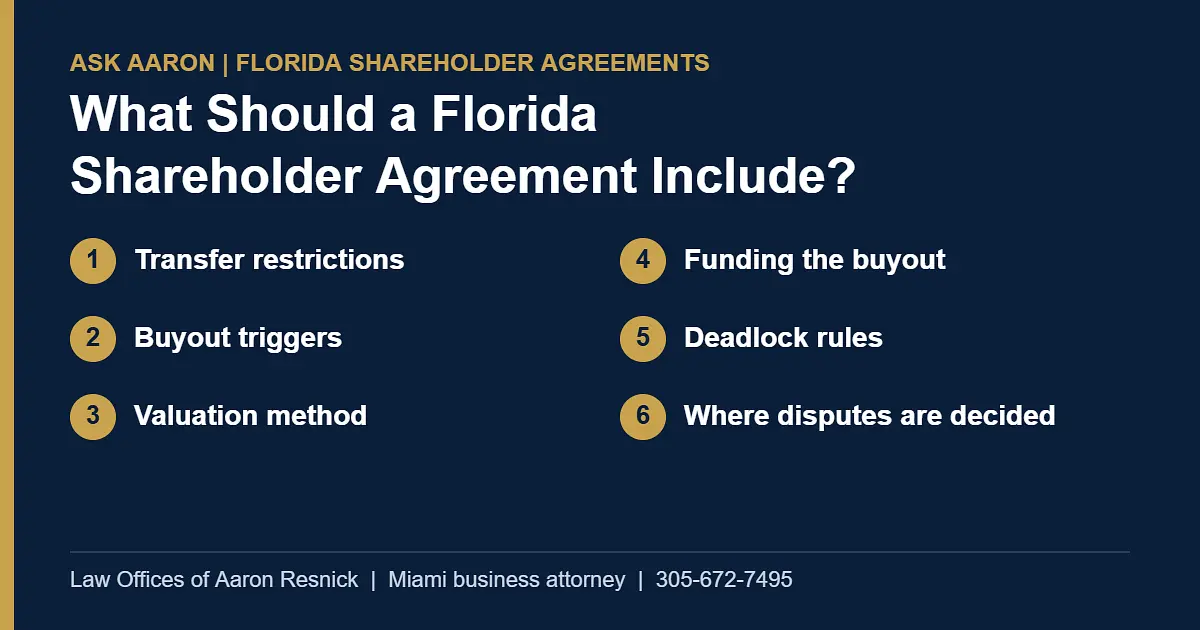
A Florida shareholder agreement should say who may sell shares and to whom, how an owner is bought out, how the shares are valued, how deadlocks are broken, who sits on the board, what information each owner gets, and where disputes are decided. Without those terms, chapter 607 and the corporation's other governing documents determine the owners' rights.
What Is a Shareholder Agreement, and Is It Different From the Bylaws?
A shareholder agreement is a contract among the owners of a corporation. The bylaws govern how the company runs: meetings, officers, notice. The shareholder agreement governs the owners themselves: their shares, their exits and their rights against each other.
In Florida, the governing law is the Florida Business Corporation Act, chapter 607, Florida Statutes. Chapter 607 allows certain shareholder agreements to change the usual rules for corporate management. The provisions must be set out or referenced in the articles or bylaws and approved by all current shareholders, or included in a written agreement signed by all current shareholders and made known to the corporation. These special rules do not invalidate other shareholder agreements that are otherwise lawful.
If the company is an LLC, the matching document is the operating agreement under chapter 605. See What Should a Florida Operating Agreement Include?
Which Clauses Matter Most?
These sections address ownership, management and exit disputes.
| Clause | What it answers | What goes wrong without it |
|---|---|---|
| Transfer restrictions | Can an owner sell or give shares to an outsider? | A stranger, a competitor or a former spouse becomes a co-owner |
| Right of first refusal | Do the other owners get the first chance to buy? | Shares leave the group before anyone can match the price |
| Buyout events | What triggers a buyout: death, disability, divorce, termination, retirement, bankruptcy | The family of a deceased owner inherits a vote no one planned for |
| Valuation method | How is a share priced: an agreed value updated yearly, a formula, or an independent appraisal | Each side hires its own appraiser and the numbers are far apart |
| Funding and payment terms | Insurance, a promissory note, an installment schedule | The company owes a buyout it cannot pay |
| Voting and board seats | Who elects directors, and which decisions need a supermajority or unanimous vote | The majority makes every decision, including ones that hurt the minority |
| Deadlock | What happens when 50/50 owners cannot agree | The company freezes, or one owner sues to dissolve it |
| Drag along and tag along | Can a majority force a sale; can a minority join one | A buyer walks away, or a minority owner is left behind in a sale |
| Information rights | What financials each owner sees, and how often | An owner has to sue just to read the books |
| Restrictive covenants | Non-compete, non-solicitation and confidentiality for owners who leave | A departing owner opens across the street with the client list |
| Dispute resolution | Court or arbitration, which county, who pays fees | A fight over where to fight, before the real fight starts |
How Should the Agreement Value the Shares?
There are three common methods, and each has a cost.
- An agreed value, updated each year. An agreed value needs a review date and a fallback if the owners do not update it. Add a fallback: if the value is more than a set time out of date, an appraisal applies.
- A formula. A multiple of earnings or revenue, or book value. Predictable, but a formula written at formation may badly misprice a company ten years later.
- An independent appraisal. The agreement can set the appraisal process and a deadline. Name the appraiser or the method of choosing one, say whether minority and marketability discounts apply, and set a deadline.
The agreement should state whether the buyout calculation includes discounts for a minority interest or limited marketability. The valuation standard and the circumstances of the buyout must also be reviewed.
What Happens if There Is No Shareholder Agreement?
Without a shareholder agreement, chapter 607 and the corporation's articles and bylaws govern. Transfer restrictions and special voting rights may still apply. Shareholders may have inspection rights or grounds to seek judicial dissolution, subject to statutory conditions. A claim for breach of duty requires a separate review of who suffered the injury and who may bring the claim.
If you are already in that position, start with Shareholder Freeze Out or Minority Shareholder Attorney in Miami.
When Does This Become Urgent?
- A new investor is about to buy in. The owners need to review the proposed terms.
- An owner has died, become disabled, divorced or left the company, and the agreement is silent or missing.
- Two equal owners have stopped agreeing on major decisions. See Breaking a 50/50 Deadlock.
- An owner wants to sell to an outside buyer and the others object.
- The company is about to be sold, and the owners do not agree on the price or the split.
What Usually Goes Wrong?
- The agreement was copied from a form. It names the wrong state, the wrong entity type, or rules that conflict with the bylaws.
- The valuation was never updated. The agreed price is from the year the company started.
- The buyout has no money behind it. No insurance, no payment schedule, no security.
- A later investor's rights were not checked. The agreement, share notices and applicable law determine how an existing restriction affects a new shareholder.
- The S corporation election is unprotected. A transfer to an ineligible owner can end the company's S corporation tax status. The agreement should block those transfers.
What Should You Have Ready?
- The articles of incorporation and the bylaws
- Any existing shareholder agreement, amendments and side letters
- The stock ledger or cap table showing who owns what
- The last two years of financial statements and tax returns
- Any life or disability insurance on the owners
- A short list of what each owner wants to happen if they leave
Send the parties, the problem and the next date; the firm reviews every inquiry and tells you whether it can help.
What Typically Happens Next?
For a new agreement, the first meeting covers the owners' goals and the hard questions: what happens on death, divorce, departure and deadlock. The next steps can include a draft, comments from the owners and the approvals or signatures the agreement requires. For a company that already has an agreement, Aaron Resnick, a Miami business attorney, reviews it against the bylaws and the current ownership and flags the gaps. When owners are already in dispute, the review starts with what the agreement allows and what chapter 607 adds.
Related Questions
- What Should a Florida Operating Agreement Include?
- Shareholder Freeze Out
- Breaking a 50/50 Deadlock
- Removing a Business Partner
- Partnership and Shareholder Disputes
Aaron Resnick has handled business disputes in Miami since 1998 and is a fourth generation Miami resident. He works hands-on on every case; the client gets Aaron on every major litigation issue, not a junior partner. The Law Offices of Aaron Resnick represents business owners, partners, members and shareholders in Miami Dade, Broward and Palm Beach counties and across Florida in partnership, LLC and shareholder disputes, buyouts and dissolutions. Call 305-672-7495 or request a consultation.
This article is general information about Florida law, not legal advice for your situation.
AUTHOR
Aaron R. Resnick
TOPICS
Speak to Aaron
Tell Aaron what happened. The firm reviews every inquiry and tells you whether it can help.
Contact Our Firm
BLOGS & ARTICLES
Latest Blog Posts
Explore articles designed to help you better understand your legal options, protect your interests, and make informed decisions for the future.