November 09, 2026
What Should a Lawyer Check Before You Sign a Business Contract?
Before you sign, a lawyer should check what you owe and when, how either side can end the contract, whether you are personally liable, what the other side...
Short Answer
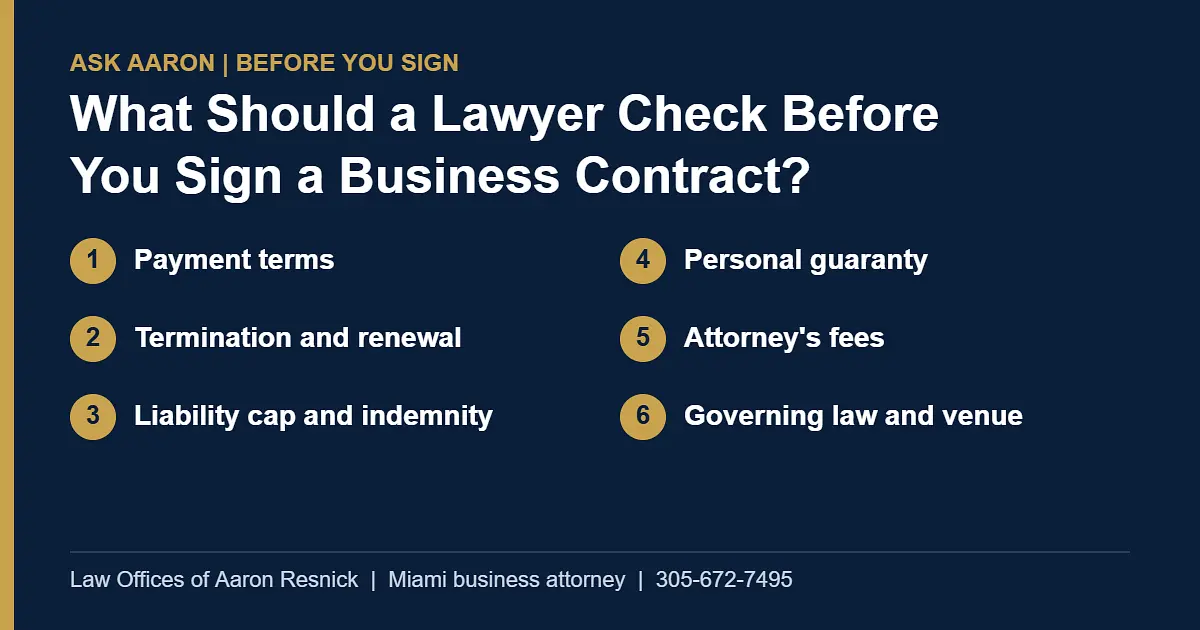
Before you sign, a lawyer should check what you owe and when, how either side can end the contract, whether you are personally liable, what the other side can recover from you, who pays legal fees, and where a dispute must be filed. A review before signing gives the parties an opportunity to negotiate those terms.
Which Clauses Should a Lawyer Review?
Aaron Resnick, a Miami business attorney who has handled business disputes since 1998, reads a contract the way a judge would read it later. These are the clauses he checks first.
| Clause | The question to ask | The common trap |
|---|---|---|
| Scope and deliverables | Exactly what is each side promising? | Vague words like "industry standard" or "as needed" |
| Payment terms | When is money due, and what triggers it? | Payment tied to "acceptance" that the other side controls |
| Term and renewal | When does it end, and does it renew on its own? | An automatic renewal with a short notice window |
| Termination | Can you leave early, and at what cost? | Only the other side can terminate for convenience |
| Limitation of liability | Is there a cap on damages, and does it apply to both sides? | Their exposure is capped; yours is not |
| Indemnity | Who covers third party claims? | You indemnify them for their own mistakes |
| Personal guaranty | Are you signing for the company, or for yourself? | A guaranty buried in the signature block |
| Restrictive covenants | Non-compete, non-solicitation, confidentiality | Terms too broad to enforce, or broad enough to stop your business |
| Attorney's fees | Who pays if there is a lawsuit? | No fee clause; check whether a statute or another recognized basis permits recovery |
| Choice of law and forum | Which state's law, which court or arbitration, which county? | A dispute you must bring in another state |
| Notice | How must notices be sent, and to whom? | A notice sent by email when the contract requires certified mail |
Are You Signing for the Company or for Yourself?
Check the signature block first. If it shows your name alone, adds "individually", or there is a separate guaranty page, you may be personally liable for the company's obligations. A lawyer should check the company's exact legal name as it appears on the Florida Division of Corporations record, the signer's authority and capacity, and any personal guaranty. A guaranty review can address a cap, an end date or a release after specified conditions are met. For leases, see What Is a Personal Guaranty in a Florida Commercial Lease?
What Florida Rules Change the Answer?
- Some contracts must be in writing. Florida's statute of frauds, chapter 725, Florida Statutes, generally requires a signed writing for an agreement that cannot be performed within one year from when it is made. The writing must be signed by the party against whom enforcement is sought or that party's authorized agent. See Is a Verbal Agreement Binding?
- Restrictive covenants must meet chapter 542. Chapter 542 generally requires a signed writing, a legitimate business interest and reasonable limits on a restrictive covenant. The Florida CHOICE Act, also in chapter 542, sets a separate framework for covered employment agreements. The review must identify which framework applies (chapter 542, Florida Statutes).
- A one-sided fee clause usually works both ways. Under chapter 57, Florida Statutes, when a contract gives one party a right to attorney's fees for enforcing the contract, a court may also award reasonable fees to the other party if that party prevails in an action concerning the contract. This rule applies to contracts entered into on or after October 1, 1988.
- Deadlines to sue are set by chapter 95. Under chapter 95, the general filing periods are five years for an action founded on a written instrument and four years for an action not founded on one. The claim, the date it accrued and any applicable exception must also be checked (chapter 95, Florida Statutes). Under chapter 95, a contract term that shortens the applicable statutory period for filing an action arising from the contract is void. Separate notice requirements still need review.
When Does This Become Urgent?
- The other side wants the contract signed today.
- The contract is long, or it is their form and you were told it is "standard".
- It runs for years, renews on its own, or carries a large total value.
- You are being asked for a personal guaranty, a non-compete or an exclusivity promise.
- The dispute clause sends you to arbitration or to another state.
What Usually Goes Wrong?
- The emails promised one thing; the contract says another. A lawyer should compare the final contract with the emails and proposals and check any clause addressing earlier discussions.
- Exhibits were never attached. The price list or scope of work is "attached as Exhibit A", and Exhibit A is missing or blank.
- The wrong entity signed. The contract names a company that does not exist or is inactive on the state record.
- No one tracked the notice window. An automatic renewal locks in another full term.
What Should You Have Ready?
- The full contract, with every exhibit, schedule and referenced document
- Emails or proposals that describe what was agreed
- The other party's full legal name and the entity you will sign for
- Your deadline to sign
- A short note on what matters most to you: price, exit, liability or timing
Send the parties, the problem and the next date; the firm reviews every inquiry and tells you whether it can help.
What Typically Happens Next?
Aaron Resnick reads the contract and marks the clauses that create risk, ranked by what they could cost. You get a short list of proposed changes and the reasons for them. If you want, he negotiates the changes with the other side or its lawyer. If the contract is already signed and a dispute has started, the review becomes a read of your rights and options under the contract as written. See Contract Drafting and Negotiation.
Related Questions
- How to Get Out of a Contract
- Is a Verbal Agreement Binding?
- Breach of Contract Damages
- What Should I Check Before Signing a Commercial Lease in Miami?
- How to Sue for Breach of Contract
Aaron Resnick has handled business disputes in Miami since 1998 and is a fourth generation Miami attorney. He works hands-on on every case; the client gets Aaron on every major litigation issue, not a junior partner. The Law Offices of Aaron Resnick represents business owners, companies, buyers, sellers and service providers in Miami Dade, Broward and Palm Beach counties and across Florida in contract drafting, review, negotiation and breach disputes. Call 305-672-7495 or request a consultation.
This article is general information about Florida law, not legal advice for your situation.
AUTHOR
Aaron R. Resnick
TOPICS
Speak to Aaron
Tell Aaron what happened. The firm reviews every inquiry and tells you whether it can help.
Contact Our Firm
BLOGS & ARTICLES
Latest Blog Posts
Explore articles designed to help you better understand your legal options, protect your interests, and make informed decisions for the future.